AI is rewriting your charity emails before supporters read them
And how we measure email marketing & fundraising success is about to completely change
Last week I opened a charity email on my phone and didn’t read it, because AI already had.
At the top of the message, Gmail had generated a summary: It pulled out what it thought mattered, highlighted an action, and nudged me towards adding something to my calendar.
I didn’t even scroll past the logo at the top of the page, and it’s a moment that should make anyone working in charity marketing or fundraising take a minute, because this isn’t just a new feature, it’s a complete shift in how supporters experience your emails.
The supporter journey has changed
For years, charity email strategy has followed a familiar rhythm:
Open → read → feel something → click → act
Whether that action is donating, signing a petition, registering for an event, or simply learning more, the journey has always relied on the email itself doing the work.
But that’s no longer guaranteed, because now there’s an extra layer sitting in the middle: Interpretation.
Before someone reads your email, AI may summarise it, and that summary becomes the first (and sometimes only) touchpoint. Which means the journey is no longer linear, or even fully visible.
It might look like:
Open → scan summary → click a surfaced link or suggested action
Open → scan summary → ask AI to pull out the key link (“take me to donate”, “show me the event”)
Open → scan summary → search for the organisation or campaign separately
Open → scan summary → do nothing, but still register the message
In some cases, the supporter never reads the email body at all, and this is where things get uncomfortable for fundraising and marketing teams.
Because parts of this journey may not be trackable in the way we’re used to.
You could see an open with no click, but a donation still happens, traffic arriving via direct or branded search rather than email or engagement that doesn’t show up cleanly in campaign reporting
So the question shifts from: “Did they click the email?” to: “Did the email influence the action — even if we can’t fully see how?”
Why I think this matters more for charities than any other sector
In most sectors, emails are about information or selling. In charities, they’re about emotion, urgency, and connection. You’re not just sharing updates. You’re building trust with supporters, helping people understand complex issues and ultimately creating moments that lead to action (often quickly)
And that usually relies on storytelling.
A real person.
A build-up.
A moment of tension.
A clear, meaningful ask.
But if AI summarises your email, it might not always preserve that journey.
It could compress it or highlight the content you meant to just make a nod to, which means we as a sector might finally be forced to break up with our chunky monthly newsletter.
Why?
It’s still early days, but from initial testing, AI can’t follow a story about a beneficiary, an event reminder, a donation ask, and a “just in case you missed it” link.
I’m not sure what Gemini’s Gmail prioritisation framework is yet, but I imagine context will be missed, not because the email format is wrong per se, but because it’s not clear enough about what mattered most.
Where audience-led charities have an advantage
If your email programme is already grounded in supporter understanding, you’re in a much stronger position.
Because when you’re clear on:
Who you’re talking to
What they care about right now
Which action matters most
Your emails tend to be more focused, and that focus translates well, even when AI summarises your content.
The essence still comes through, maybe not perfectly, but clearly enough to guide action.
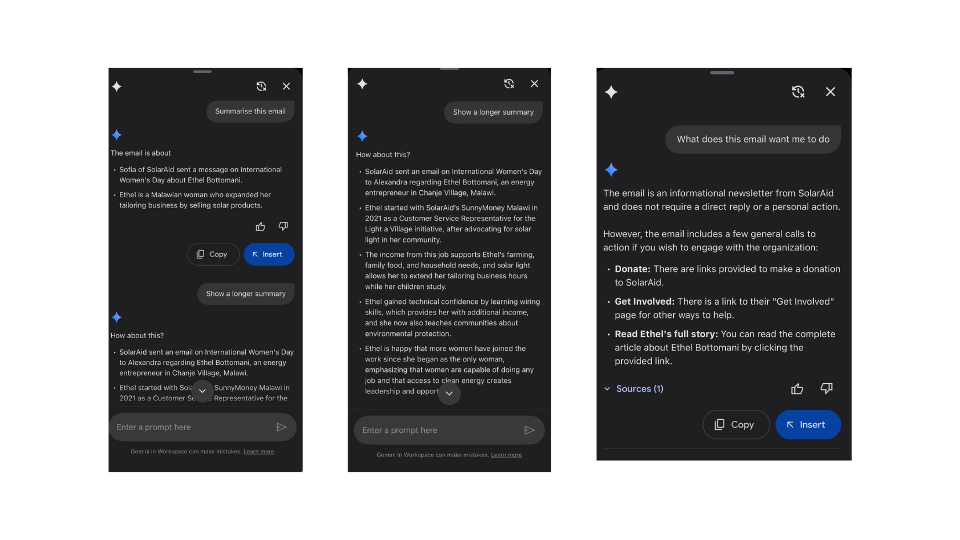
Here’s an example of an AI-summary in action from one of my favourite personal charities, SolarAid.
A quick way to sense-check your emails
If you want to see how this is already affecting you, there’s a simple test.
Open your emails in an inbox that uses AI summaries (Gmail is the easiest place to start).
Look at:
What it pulls out as the main point
Which link or action it highlights
What it leaves out
This is where things get interesting. You might notice that your donation ask isn’t being surfaced, key emotional context is missing, or your email just feels a little flatter than intended. When that happens, it’s usually a sign that the email is trying to carry too much.

Key takeaway
AI hasn’t removed the need for charity emails at all (I still think they’re the most underutilised organic digital channel for charities), but it has changed where meaning is created.
It’s no longer just in your story, your structure, or your CTA.
It’s in how your email is interpreted before it’s even read, and the charities that adapt quickest will embrace segmentation, personalisation and scale, and finally give email the love and attention it deserves internally.